

How To Place A Shift Register Labview

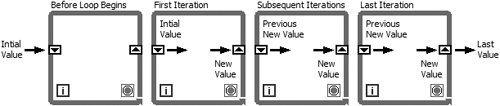
Shift registers, available for While Loops and For Loops, are a special blazon of variable used to transfer values from one iteration of a loop to the next (come across Effigy vi.14). They are unique to and necessary for LabVIEW'south graphical structure; we'll talk more about their uses in a lilliputian while. You create a shift register past popping upwardly on the left or right loop edge and selecting Add Shift Register from the pop-upwardly menu.
Effigy 6.14. Shift registers
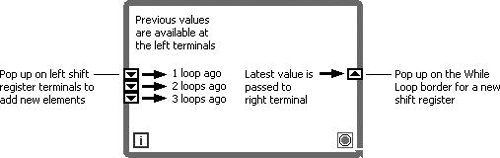
You can configure the shift register to call back values from several previous iterations, as shown in Figure vi.fifteen, a useful feature when you are averaging data values acquired in dissimilar iterations. To admission values from previous iterations, create additional terminals by popping upwards on the left last and choosing Add together Chemical element from the pop-upward carte. Alternatively, you can create additional concluding elements past hovering over the Shift Register and dragging the catch handles that appear.
Effigy 6.fifteen. A While Loop having one shift register with multiple left terminal elements
You can accept many dissimilar shift registers storing many different variables on the same loop. Merely pop up on the loop edge and add them until yous have as many pairs as you need. The left final will always stay parallel with its right terminal; if y'all move one, they both move. And so if you lot take a lot of shift registers on your loop and can't tell exactly which ones are parallel, but select one and its partner volition be automatically selected, or movement one final a fiddling and watch its mate follow.
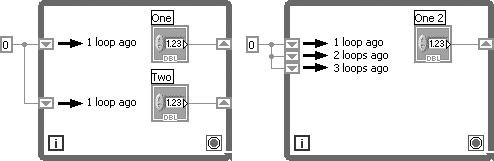
Don't make the mutual mistake of confusing multiple variables stored in multiple shift registers with a single variable stored from multiple previous iterations in one shift register. Figure six.xvi shows the difference.
Figure 6.sixteen. (Left) Two separate variables. (Correct) Several loop values of one variable.
If y'all're withal a little confused, don't worry. Shift registers are a completely new and different concept, unlike anything you may accept encountered in a traditional programming linguistic communication. Stepping through the next practice should demonstrate them more conspicuously for y'all.

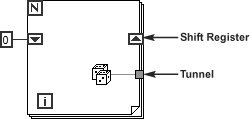
Make certain to wire straight to the shift register final so that you don't accidentally create an unrelated tunnel into or out of the loop. Effigy 6.17 shows the difference between a shift register and a tunnel.
Figure 6.17. Shift annals and tunnel, two different means of passing data through the walls of a loop
Activity 6-2: Shift Annals Example
To requite yous an idea of how shift registers work, you lot will notice their use to access values from previous iterations of a loop. In this 6, you volition be retrieving count values from previous loops.
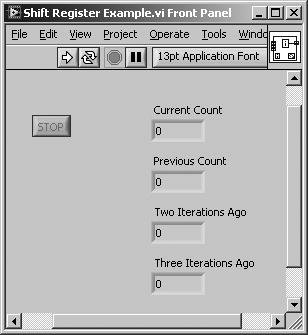
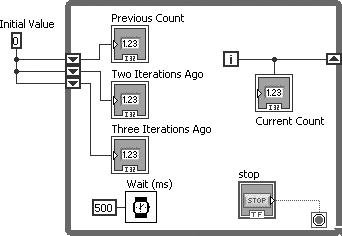
| one. | Open Shift Register Example.vi, located in Everyone\CH06(run across Figure 6.18). Effigy 6.18. Shift Register Example.vi front console The front console has four digital indicators. The Electric current Count indicator volition display the electric current value of the loop count (information technology is wired to the iteration terminal). The Previous Count indicator volition display the value of the loop count i iteration ago. The 2 Iterations Agone indicator will brandish the value from two iterations agone, and so on (see Effigy 6.19). Figure six.19. Shift Register Example.vi block diagram |
| 2. | Open up the block diagram window past choosing Prove Diagram from the Windows menu. The zero wired to the left shift annals terminals initializes the elements of the shift register to cipher. At the commencement of the next iteration, the old Electric current Countvalue volition shift to the top left last to become Previous Count. Previous Countshifts down into Two Iterations Agone, and and so on. The timer function Await (ms) tells the loop to wait 500 ms before iterating. |
| 3. | Later on examining the block diagram, show both the console and the diagram at the same time past choosing Tile Left and Right from the Windows menu. |
| iv. | Enable the execution highlighting past clicking on the Execution Highlighting button. |
| 5. | Run the Half dozen and advisedly lookout man the bubbles. If the bubbles are moving besides fast, end the VI and click on the Step Into button to put the Half-dozen in single-footstep mode. Click on the button again to execute each step of the Vi. Watch how the forepart console indicator values alter. Observe that in each iteration of the While Loop, the VI "funnels" the previous values through the left terminals of the shift register using a get-go in, kickoff out (FIFO) algorithm. Each iteration of the loop increments the count terminal wired to the right shift register terminal, Electric current Count, of the shift register. This value shifts to the left last, Previous Count, at the beginning of the side by side iteration. The rest of the shift register values at the left terminal funnel down through the terminals. In this example, the VI retains just the last iii values. To retain more than values, add more elements to the left terminal of the shift register by popping upwardly on it and selecting Add Element.End the Half-dozen by pressing the STOP push on the front panel. If y'all are in single-footstep fashion, keep pressing the stride push until information technology completes. |
| half dozen. | Shut the VI. Do not salvage any changes. Another job well done! |


Why Y'all Need Shift Registers
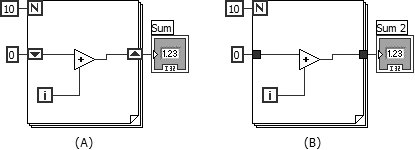
Notice the example illustrated in Figure half-dozen.twenty. In loop (A), you are creating a running sum of the iteration count. Each time through the loop, the new sum is saved in the shift register. At the end of the loop, the total sum of 45 is passed out to the numeric indicator. In loop (B), y'all have no shift registers, so you cannot salve values between iterations. Instead, you add cypher to the current "i" each fourth dimension, and only the concluding value of 9 will exist passed out of the loop.
Figure 6.20. 2 loops showing the divergence between shift registers (A) and tunnels (B)
Or what about a case where you lot need to boilerplate values from successive loop iterations? Maybe you desire to take a temperature reading once per second, and then average those values over an hour. Given LabVIEW's graphical nature, how could you wire a value produced in one loop iteration into the side by side iteration without using a shift register?
Initializing Shift Registers
To avoid unforeseen and possibly nasty beliefs, you should e'er initialize your shift registers unless you have a specific reason not to and brand a conscious decision to that effect. To initialize the shift annals with a specific value, wire that value to all the left terminals of the shift annals from outside the loop, equally shown in the left ii loops in Figure 6.21. If you do not initialize information technology, the initial value will be the default value for the shift register information type the first time you run your programme. In subsequent runs, the shift register volition contain whatsoever values are left over from previous runs.
Figure six.21. Ii loops (left and correct) on subsequent iterations (meridian and bottom) showing the effect of uninitialized shift registers (right) vs. initialized shift registers (left)
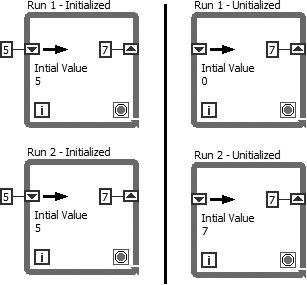
For example, if the shift register data type is Boolean, the initial value will be Simulated for the outset run. Similarly, if the shift register information blazon is numeric, the initial value will be nada. The second time yous run your VI, an uninitialized shift annals will comprise values left over from the offset run! Study Figure 6.21 to make sure you empathise what initialization does. The two loops in the left column show what happens when you run a program that contains an initialized shift register twice. The right column shows what happens if you run a plan containing an uninitialized shift register two times. Note the initial values of the shift registers in the 2 bottom loops.
LabVIEW does not discard values stored in the shift register until you shut the 6 and remove it from memory. In other words, if you run a VI containing uninitialized shift registers, the initial values for the subsequent run will exist the ones left over from the previous run. You lot seldom want this behavior (although in that location are some avant-garde uses such as the "Functional Global," which will be discussed in Appendix D, "LabVIEW Object-Oriented Programming") and the resulting problems can be very difficult to spot!
If y'all resize a shift register to show multiple previous iterations (on the left shift annals), LabVIEW requires you to initialize all the shift register elements if any shift register elements are initialized. Otherwise, your Vi will be broken (unable to run).
The Feedback Node
Generally, LabVIEW does non let yous to create a "cycle," where the output of block of lawmaking is used as the input for the same cake of codeand attempting to do and then volition cause wires to get broken. Y'all can see an instance of a "cycle" in Figure 6.22. The wheel is broken due to the data flow rules, which state that (ane) a node cannot execute until information flows into all of its input terminals and that (two) data does not flow out of a node'south output terminals until the node finishes executing. Because a "cycle" uses the output terminals as a source for the input terminals, data can never flow into the input terminals because data will never flow out of the output terminals, because the node will non run until data flows into the input terminalsquite a paradox.
Figure half dozen.22. A cycle, which is broken due to an input depending on an output
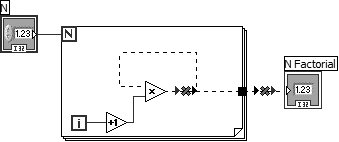
However, if we are inside a While Loop or For Loop, we can place a Feedback Node in between the output final and the input last, and our code will at present work. Yous can see an example of this in Figure half dozen.23. In fact, by default, LabVIEW will automatically identify a Feedback Node in your cycle, when it is created, if you are inside a While Loop or For Loop. This setting is controlled by the Auto-insert Feedback Nodes in cycles checkbox in the Block Diagram section of the LabVIEW options dialog.
Figure 6.23. A feedback node allows the cycle to piece of work
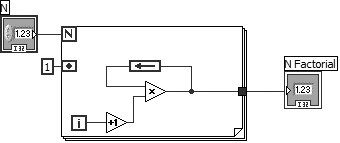
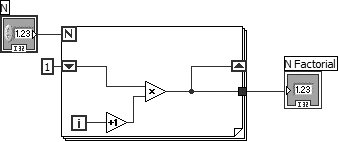
To sympathize exactly how the Feedback Node works, we should realize that a Feedback Node is really simply a Shift Register in disguise. In fact, the code in Effigy 6.23 is equivalent to the code in Effigy 6.24. The first affair to notation is that the pointer on the Feedback Node indicates the management of data menstruum. The input terminal of the Feedback Node is equivalent to the right last of a Shift Register, and the output terminal of the Feedback node is equivalent to the left terminal of a Shift Annals. For initializing a Feedback Node, we utilise the Initializer Terminal, which tin be shown or hidden by right-clicking on the Feedback Node and selecting or deselecting the Initializer Terminal choice. You can hands catechumen a Feedback Node to a Shift Annals, and vice versa; merely right-click on the Feedback Node and select Replace with Shift Register or right-click on the Shift Register and select Replace with Feedback Node.
Figure 6.24. A shift register created from a cycle (using the Replace with Shift Register characteristic)
Converting Tunnels to Shift Registers (and Vice Versa)
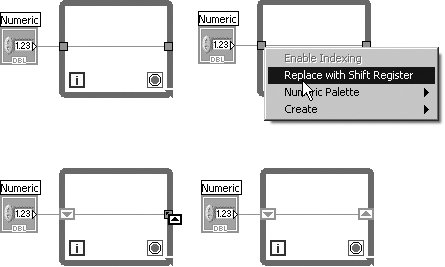
You may realize, in the process of writing your code, that a tunnel should in fact exist replaced past a shift register. Fortunately, LabVIEW makes this very easysimply right-click on the tunnel and select Replace with Shift Register from the pop-up menu (Figure half-dozen.25).
Effigy 6.25. Replacing input and output tunnels with a shift register

Shift Register Cursor
The first thing you volition notice is that the tunnel is replaced by a shift register. Also, you volition notice that the mouse cursor now appears as a Shift Register Cursor. Employ this cursor to select (mouse-click) another tunnel that y'all wish to convert to the opposing side of the shift register, or click anywhere on or inside the loop to place the opposing side of the shift annals without converting some other tunnel (encounter Figure 6.25).
To convert a shift annals into tunnels, simply right-click on the shift register and select Replace with Tunnels from the pop-up carte du jour.

How To Place A Shift Register Labview,
Source: https://flylib.com/books/en/3.352.1.75/1/
Posted by: daltonalayeaker.blogspot.com
0 Response to "How To Place A Shift Register Labview"
Post a Comment